Orton-Gillingham: what it is and what the evidence says
Dyslexia Therapy 7 min read
Orton-Gillingham is an approach to teaching reading and spelling in which letters and sounds are taught directly, one at a time and in a set order, using sight, sound, touch and movement together. Published reviews have not been able to show that it works better than other explicit, systematic teaching, mainly because the studies are few and weak. A child with dyslexia needs the kind of teaching it belongs to more than they need the name.
This guide covers what Orton-Gillingham is, how it relates to structured literacy and to MSL in Australia, what three published reviews found, and what to ask a tutor who advertises it. Dyslexia Therapy does not sell Orton-Gillingham training or materials.
What is Orton-Gillingham?
Orton-Gillingham is named after Samuel Orton, an American neuropsychiatrist, and Anna Gillingham, an educator and psychologist, who developed it in the United States in the 1930s for children who struggled to learn to read. Gillingham published the teaching manual with Bessie Stillman in the mid 1930s.
It is an approach, not a single product. Nobody owns it, and the US Department of Education’s What Works Clearinghouse notes that “there is no developer for this approach”. Many commercial programs are built on its principles. The Clearinghouse lists the Wilson Reading System and the Barton Reading and Spelling System among them.
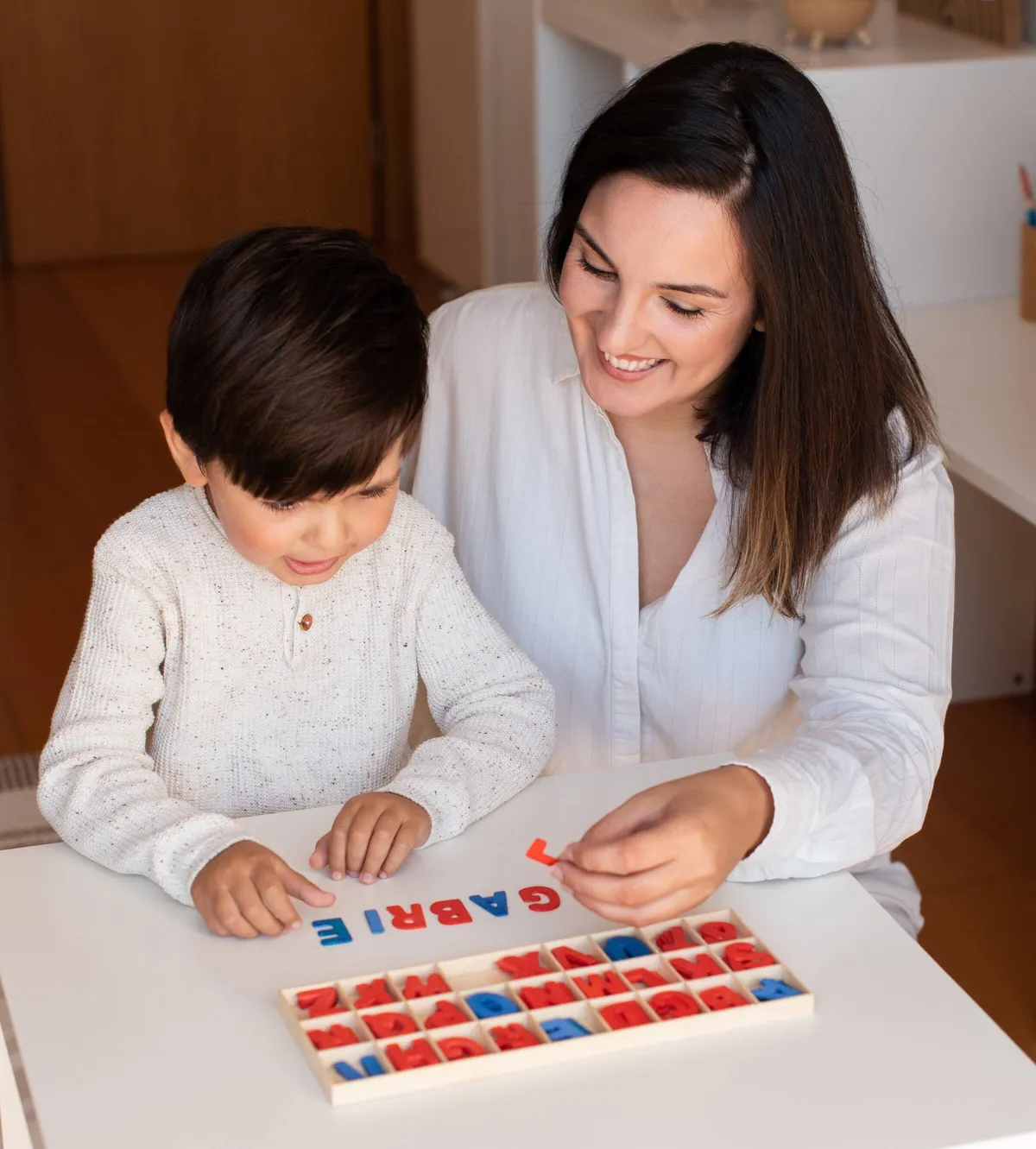
The researchers who reviewed it in 2021 describe Orton-Gillingham as “a direct, explicit, multisensory, structured, sequential, diagnostic, and prescriptive approach”. In a lesson, that means a child is taught one letter pattern at a time, practises blending those patterns into words, and goes back over earlier material often. The teacher chooses what comes next from what the child got wrong. The same researchers give this example of the multisensory part: seeing the letters “sh” on a card, hearing the sound they make and tracing the letters on a textured mat, all at once.
How does Orton-Gillingham relate to structured literacy?
Orton-Gillingham is one of the oldest members of the family of teaching now called structured literacy. Structured literacy is the general name for teaching reading and spelling explicitly and in a planned order, starting with the links between speech sounds and letters. The structured literacy guide explains what that looks like week to week.
Most of what Orton-Gillingham does is shared with that wider family. AUSPELD, the Australian federation of SPELD associations, says the approach “incorporates several evidence-based principles, including a focus on language-literacy links and the teaching of systematic synthetic phonics”. The 2021 review makes the same point from the other side: programs that do not use the Orton-Gillingham name “have adopted many of the descriptors or characteristics” of it.
Is MSL the same as Orton-Gillingham in Australia?
In Australia, a tutor who advertises MSL is usually describing Orton-Gillingham under another name. MSL stands for multisensory structured language. The Australian Dyslexia Association’s fact sheet says the two terms “are generally interchangeable”, and its training page describes MSL as “a pedagogy and not another program”.
The Australian Dyslexia Association accredits people who have completed MSL training with the Institute for Multisensory Language Education, and calls them accredited members. So “MSL trained” and “Orton-Gillingham trained” can describe a real course of study. Neither phrase says how long the training was or whether the tutor’s teaching was supervised, which is why the questions further down matter.
What did the published reviews of Orton-Gillingham find?
Three published reviews have looked at the research on Orton-Gillingham, and none found enough good evidence to say it works better than the teaching it was compared with. None found that it does not work either.
| Review | What it looked at | What it found |
|---|---|---|
| Ritchey and Goeke, 2006, Journal of Special Education | 12 studies. The approach did better on every measure in 5 and on some in 4 | The 2021 authors summarise it: “the research was simply insufficient, in the number of studies conducted and study quality, to support OG instruction as an evidence-based practice” |
| What Works Clearinghouse, 2010, US Department of Education | 31 studies of unbranded teaching based on the approach, published 1989 to 2009 | “None of the 31 studies meet WWC evidence standards”. The Clearinghouse was “unable to draw any conclusions based on research about the effectiveness or ineffectiveness” of the method |
| Stevens and colleagues, 2021, Exceptional Children (a meta-analysis) | 24 studies of students with or at risk of word reading difficulty; 16 could be combined | The interventions did “not statistically significantly improve foundational skill outcomes”, although the average effect “was positive in favor of” them |
The 2021 meta-analysis is the most complete of the three. Across phonological awareness, phonics, fluency and spelling, the average effect size was 0.22, which was not statistically significant (p = .40). For vocabulary and comprehension it was 0.14 (p = .59). The authors also rated the studies themselves and found that “the overall study quality of the corpus was low, limiting confidence in the findings”.
Their conclusion is careful in both directions. The findings “do not definitively prove that OG interventions are not impactful for students with dyslexia”, and the authors add that they “are not suggesting that other reading programs are more effective than OG”. Their summary of the evidence is “promise but not confidence”.
Does the multisensory part make the difference?
The research so far does not show that the multisensory part is what helps. The 2021 authors suggest that using several senses at once “may be the defining feature that sets OG interventions apart”. They then report that “current research does not indicate that the simultaneous use of these senses positively impacts students reading outcomes”. AUSPELD reaches the same view: the efficacy of multisensory instruction, “a term that is not well-defined”, “is not supported by the research evidence”.
That does not make tracing a letter in sand a bad idea. Almost all early reading teaching has a child look at letters, say sounds and write words. What the research cannot yet show is that doing all of these at the same moment adds something beyond clear, well ordered teaching and plenty of practice.
Does my child need Orton-Gillingham, or the method behind it?
A child with dyslexia needs the method, and the method is not exclusive to Orton-Gillingham. Healthdirect, the Australian Government’s health advice service, says a child with dyslexia “will benefit from being taught phonemic awareness and phonics (structured synthetic phonics)”. That teaching can come from a learning support teacher, a tutor or a speech pathologist.
Taught well, Orton-Gillingham delivers exactly that. So do other structured programs. AUSPELD notes that the programs based on it have “varied levels of effectiveness”, which means the name by itself guarantees nothing. The dyslexia treatment guide sets out what the evidence supports and what it does not.
What separates good teaching from poor is easier to check than a brand: sounds and letters taught explicitly, a planned order, constant review, enough practice, and progress that is measured. The 2021 authors put it this way: current evidence “does not suggest confidence that this is the only approach to remediating word-reading difficulties”.
What should I ask a tutor who advertises Orton-Gillingham?
Ask a tutor who advertises Orton-Gillingham or MSL about their program, their training and how much real reading the lessons involve. The name tells you the style of teaching; these three questions tell you what sits behind it.
- Which program or materials do you teach from? Orton-Gillingham is an approach, so two tutors using the name may teach from different materials.
- What training did you complete, who provided it, and was your teaching supervised? Ask how long it ran, whether it included teaching real students under observation, and whether it led to accreditation with the Australian Dyslexia Association.
- How much of each session is reading and spelling real words and sentences? Cards and drills are a means. Reading and writing connected text is the goal.
Be cautious about a claim that only one brand works. The reviews above do not support it.
For the general questions to ask anyone who teaches reading, such as how they will assess your child, what they will teach and in what order, and how they will measure progress, see what to ask before paying anyone, which also sets out the difference between a tutor and a speech pathologist. Dr Lauren Crumlish (PhD), a Certified Practising Speech Pathologist, works with children and teenagers up to 18 online, and dyslexia tutoring with Dr Lauren explains how that work is done.
Sources
- Stevens and colleagues (2021), Current state of the evidence: examining the effects of Orton-Gillingham reading interventions, Exceptional Children 87(4)
- What Works Clearinghouse, US Department of Education (2010), Orton-Gillingham-based strategies (unbranded)
- Ritchey and Goeke (2006), Orton-Gillingham and Orton-Gillingham-based reading instruction: a review of the literature, Journal of Special Education 40(3)
- AUSPELD, What does the research tell us about different interventions?
- Australian Dyslexia Association, What is MSL? and accredited training
- Healthdirect Australia, Dyslexia
Topics
- Orton-Gillingham
- Structured literacy
- Tutoring
- Evidence